
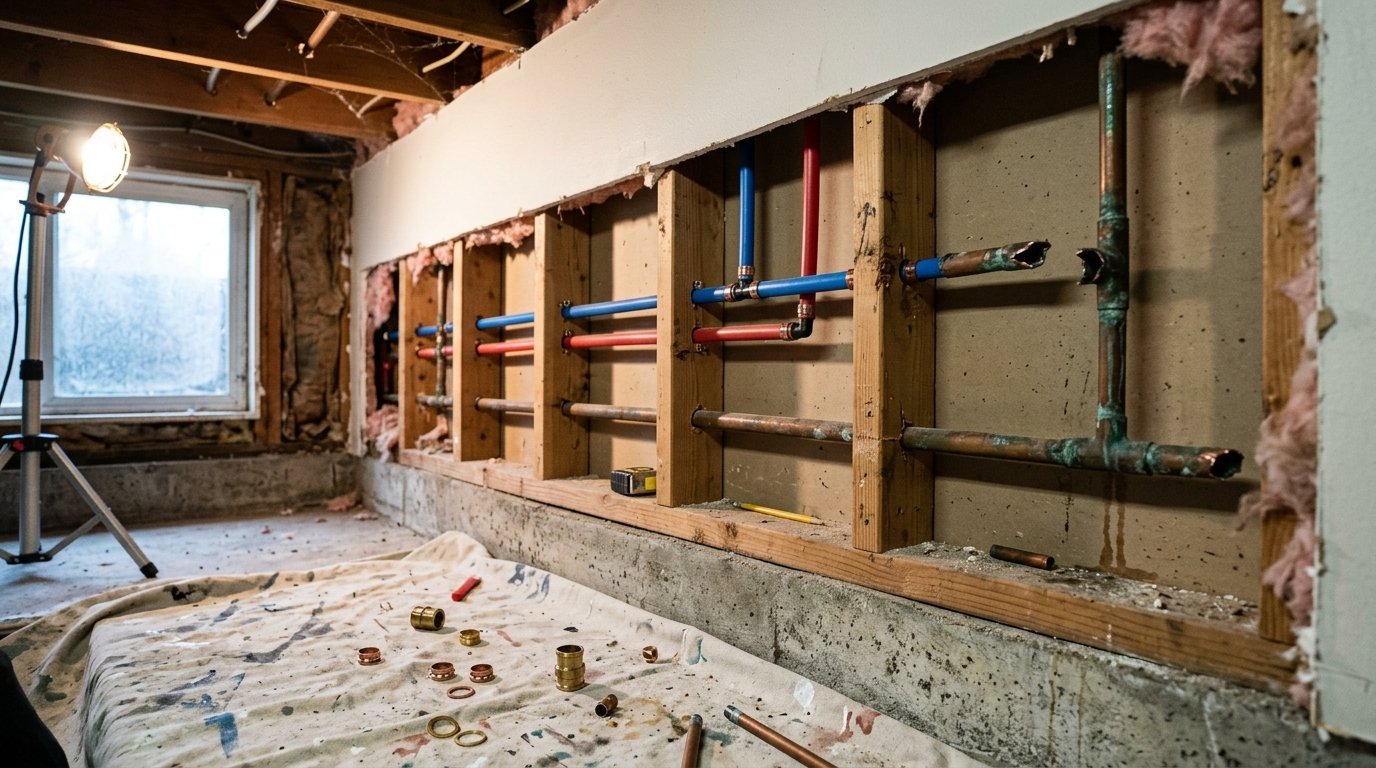
Should You Repipe Your Seattle Home With PEX or Copper
Walk into ten Seattle plumbing shops with a repipe question and seven of them will quote PEX before they’ve looked at your basement. That isn’t a conspiracy. PEX is faster to install, easier on labor margins, and works in most homes, so it’s the safe default. The problem is that your home isn’t most homes.
What’s already in your walls, what your foundation looks like, and how Seattle’s water behaves all push the answer in different directions. Sometimes hard. Skipping that conversation is how homeowners end up paying for a system that doesn’t fit the house.
For a project like repiping Seattle homes (craftsman-plumbing.com), the honest opening question isn’t “PEX or copper.” It’s “what’s actually in my walls?” Anyone willing to quote before answering that is selling, not diagnosing.
Why “PEX or copper” is the wrong opening question
The material decision is the output of a conversation, not the input. Pick a material before knowing what’s already there, what the layout looks like, and what the water is doing to whatever’s in the lines, and you’re guessing in expensive units.
What’s already in the wall is half the project
Polybutylene with brass crimp rings, common in late-70s through mid-90s housing stock, is a forced repipe. Most insurance carriers won’t write water-damage coverage on a home with polybutylene anymore, so the math stops being optional. Galvanized steel from earlier construction lands the same way. Galvanized rusts from the inside out, and by the time pressure drops noticeably at a fixture, the line wall is paper-thin.
Copper Type M (thin-wall) holds up for decades in clean water, and most of Seattle’s mid-century housing still runs it without trouble. A repipe here is a planned project, not an emergency. Copper Type L or K that’s been installed well usually doesn’t need a full project at all. Repair the runs that have actually failed and leave the rest. Replacing healthy copper is money in a hole.
Layout matters more than people expect
Seattle housing splits three ways on this question. Slab-fed homes with supply lines running under concrete are the worst-case for copper. A slab leak in copper means jackhammering. PEX can be re-routed overhead, bypassing the slab entirely, which is why most slab repipes here end up PEX whether the homeowner started there or not.
Crawlspace-fed homes flip the answer. Runs are accessible, the work is clean, and copper is at its best. If the budget supports it, copper in a crawlspace is the longest-lifespan supply system you can buy in this region. Newer wall-fed homes sit in the middle, and either material works fine.
Seattle’s water has an opinion about this
Water from the Cedar River and Tolt watersheds is soft and slightly acidic. That sounds like a small detail until it ends up driving the material decision.
The blue-green stain problem
Soft, acidic water leaches copper slowly from the inside of new pipe. In neighborhoods with the oldest copper installs, blue-green staining at fixtures shows where it’s happening. Not catastrophic, but it’s a real knock against new copper unless the install pairs it with a whole-house pH neutralizer. Add the neutralizer cost into the copper quote and the math shifts.
PEX doesn’t care about any of this. Inert to soft, acidic water. No leaching, no corrosion. In most Seattle ZIP codes that’s enough to push the answer toward PEX even when the layout would have favored copper.
Well water in unincorporated King County opens its own conversation. Iron, manganese, occasional hardness. Copper handles it, PEX handles it, and CPVC sometimes shows up when the well chemistry is corrosive enough to make both standard options nervous. CPVC is rare but not wrong for that case.
How long you’re staying changes the answer
This is the financial half of the decision, and it’s the part most plumbers won’t bring up unless the homeowner asks.
Short ownership horizon: PEX. Lower install cost, faster job, and the buyer’s insurance company won’t blink either way. The buyer at sale doesn’t care what’s in the wall as long as it isn’t polybutylene or galvanized. Paying 30 to 40 percent more for copper to recoup it at closing doesn’t pencil out.
Forever home: Copper Type L. Higher upfront cost, but it amortizes across a much longer lifespan, and there’s a quieter aesthetic argument too. Exposed copper in utility rooms reads as “this house was built right.” Buyers and home inspectors notice. Exposed PEX, fairly or not, reads as a temporary fix.
The mismatch (copper on a flip, PEX on a house you’ll never sell) is invisible in the wall but expensive on the spreadsheet.
The permit conversation is non-negotiable
Seattle requires permits on supply-line repipes, and SDCI tracks them. Anyone who tells you the quote will be cheaper “if we skip the permit” is the wrong contractor. The savings are imaginary because the work gets redone at sale, and the willingness to skip the permit usually points at other corner-cutting elsewhere on the install.
Both PEX and copper pass current Seattle code. CPVC is allowed but increasingly rare. New galvanized supply lines aren’t allowed at all. Existing galvanized can stay, but it can’t be extended.
What a working quote conversation looks like
Show up to the estimate with answers in hand: what’s currently in the walls, what the layout is, what the SPU water report says about your service area, and how long you plan to keep the place.
A plumber who can take those four data points and walk through the permit piece in a few minutes is the contractor you want. The one who skips straight to “we usually recommend PEX” without asking any of it is selling the easy quote, not the right one.
Repipes that come in over budget or with surprise change orders almost always trace back to one of those questions getting skipped. The ones that land clean trace back to a homeowner who showed up with the answers ready.
So “PEX or copper” turns out to be one of the last questions in this process, not one of the first. Get the front of the conversation right and the back almost answers itself.